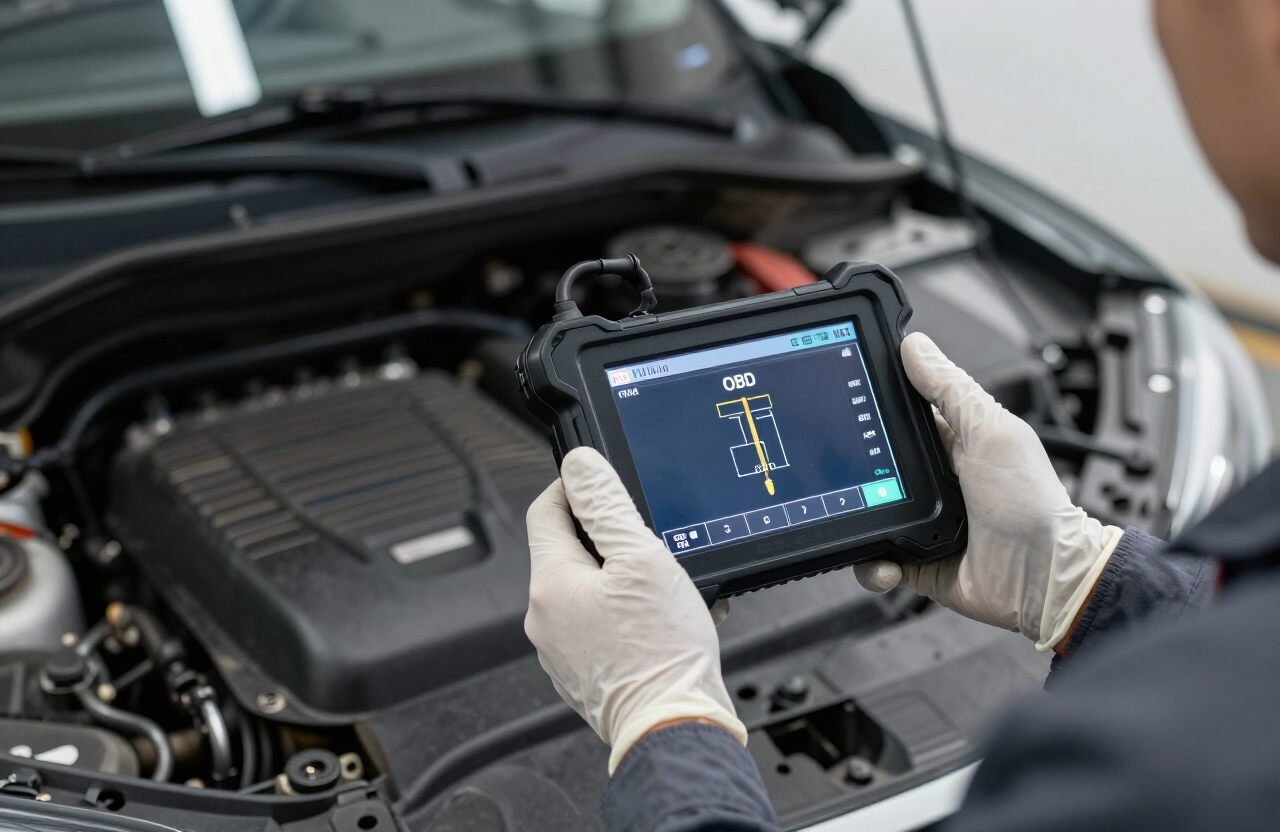
A fault code is a symptom, not a diagnosis. P0301 tells you cylinder one is misfiring; it does not tell you whether that is a coil, an injector, a valve or a head gasket. Understanding what a proper diagnostic session includes will help you judge whether a quote is fair.
Stage one: interrogation and freeze frame
The technician reads stored and pending codes from every module, not just the engine ECU, and pulls the freeze frame data captured when the fault occurred: engine speed, load, coolant temperature, fuel trims. That snapshot often tells you more than the code itself.
Stage two: live data
Live serial data shows fuel trims, mass airflow readings against expected values, lambda sensor switching, rail pressure on diesels, and misfire counters per cylinder. A long-term fuel trim sitting at plus 20 per cent is a vacuum leak or an under-reading airflow sensor long before anything else is touched.
Stage three: physical testing
This is where real diagnosis happens and where cheap code reads stop. Depending on the symptom the technician may run a smoke test for intake leaks, a pressure test on the cooling system, a relative compression test using current clamp and oscilloscope, an injector back-leak test, or a cylinder leak-down test with the engine at TDC.
What you should receive
- A written fault report naming the codes found, the tests carried out and the readings obtained.
- A conclusion that names a component or a system, with the reasoning.
- A repair estimate separated into parts and labour.
- A note of anything that could not be ruled out and why.
What it should cost
A one-hour diagnostic session is typically £50 to £120 in the UK, and many workshops credit it against authorised repair work. Complex intermittent faults are quoted in half-day blocks. Be wary of free diagnostics: the cost is usually recovered in the repair, and free almost always means code read only.
Why guessing is expensive
Parts-swapping looks cheaper per step and ends up costing more. Two coil packs, a lambda sensor and a MAF later, an unresolved misfire is still a misfire — and you have paid four labour charges instead of one diagnostic hour.

Written by
Adaeze Fowler CEng MIMechE
Technical reviewer, automotive engineer

Technically reviewed by
Gareth Mullen
Editor and IMI Master Technician (Level 4 Diagnostics)
This guidance is general. It does not replace inspection by a qualified technician on your vehicle. Read our editorial policy for how articles are researched, reviewed and updated.