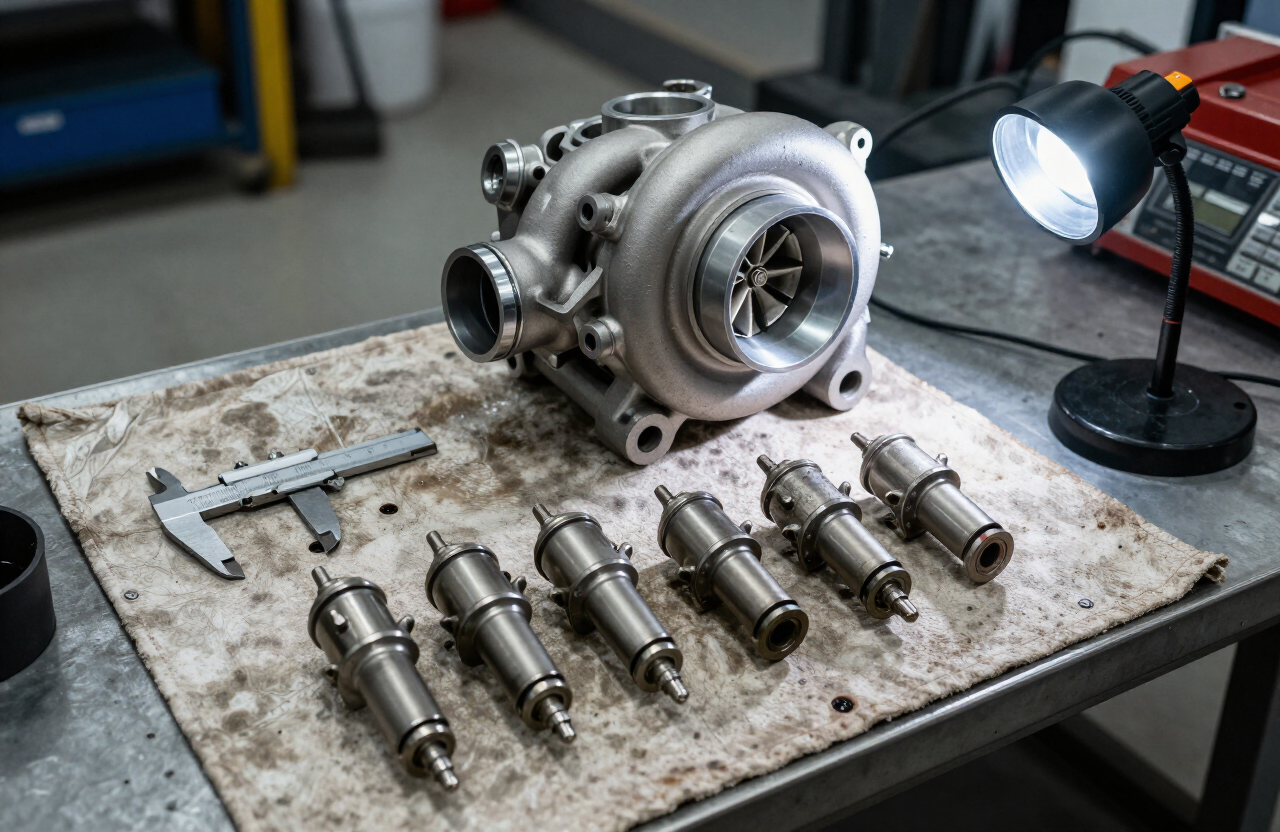
Injectors and turbochargers produce overlapping symptoms — poor power, smoke, noise, limp mode — and both are expensive. Separating them properly before parts are ordered saves a great deal of money.
Injector failure: the classic signs
- Rough, uneven idle with a distinct knock or diesel rattle from one area of the engine.
- Hard starting when hot, or extended cranking after standing.
- Black or white smoke and a smell of raw fuel.
- Rising fuel consumption with no change in driving.
- Fuel dilution in the oil, showing as a rising oil level.
How injectors are tested
A back-leak test measures how much fuel each injector returns to the tank; a leaking injector returns far more than its neighbours. Live data will also show cylinder correction values — the ECU trimming individual cylinders to keep them balanced. Consistent large negative or positive corrections on one cylinder is strong evidence.
Injectors must be coded to the ECU after replacement. Fitting new injectors without entering their calibration codes produces exactly the fault you were trying to fix.
Turbocharger failure: the classic signs
- A rising whine or siren note that changes with boost.
- Loss of power with limp mode and a boost-related fault code.
- Blue smoke on the overrun, and oil in the intercooler or intake pipework.
- Oil consumption without external leaks.
- Metallic tinkling or a rough feel when the compressor wheel is spun by hand.
Why the two are linked
A leaking injector dilutes the engine oil with diesel. Diluted oil loses film strength and starves the turbo bearing, which then fails. Fitting a new turbo without addressing the injector guarantees a second turbo failure, usually within months.
Equally, a failed turbo pushes oil into the intake, which fouls sensors and creates fuelling faults that look like injector problems.
Before fitting a new turbo
The oil feed pipe must be replaced or thoroughly cleaned, the oil and filter changed, the intercooler flushed of oil, and the cause of the original failure identified. Most turbo warranties are void without evidence of the oil feed being addressed.

Written by
Gareth Mullen
Editor and IMI Master Technician (Level 4 Diagnostics)

Technically reviewed by
Adaeze Fowler CEng MIMechE
Technical reviewer, automotive engineer
This guidance is general. It does not replace inspection by a qualified technician on your vehicle. Read our editorial policy for how articles are researched, reviewed and updated.