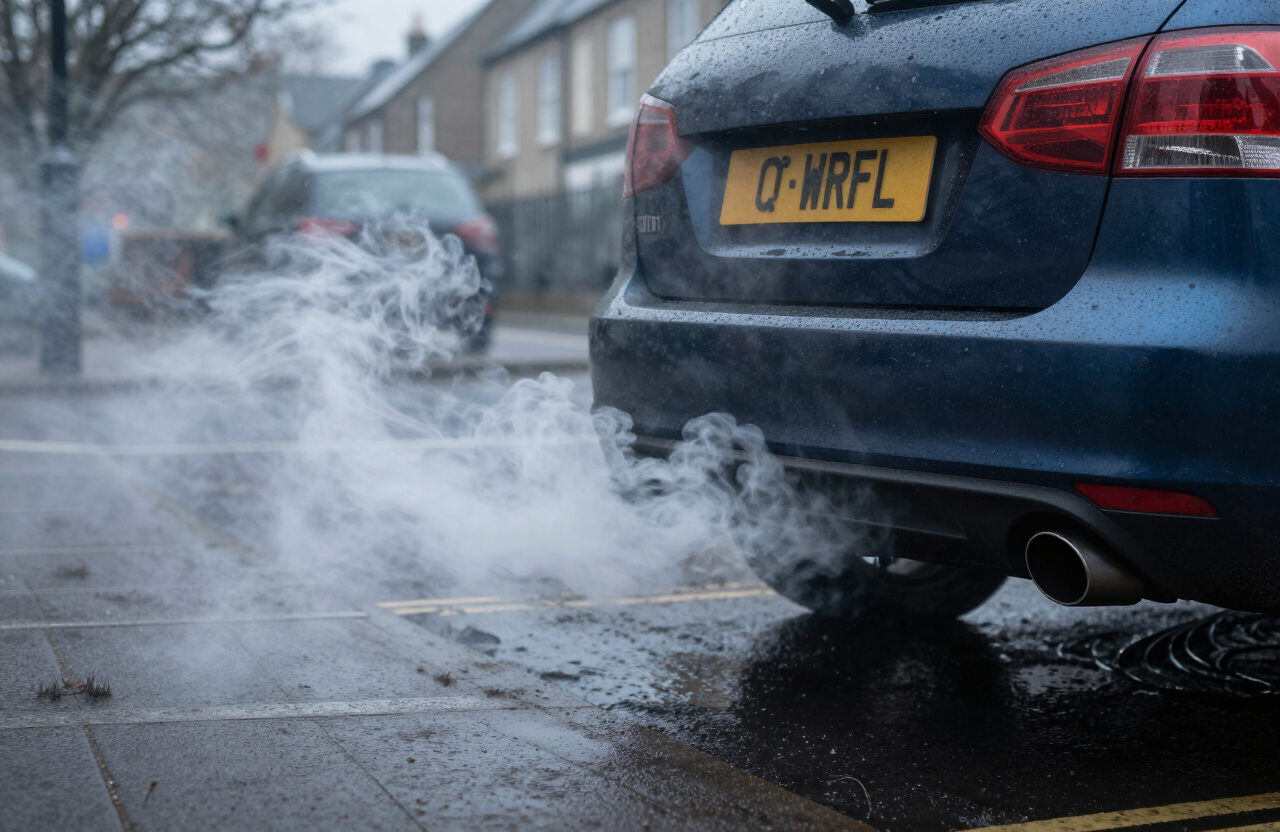
Exhaust smoke is one of the few engine symptoms you can assess yourself with reasonable confidence. Colour tells you what is burning; timing tells you where it comes from. Together they usually point at two or three candidate faults rather than twenty.
Blue smoke: oil in the combustion chamber
Blue-grey smoke with an acrid smell means engine oil is burning. On a cold start only, suspect valve stem seals — oil drains past them overnight and burns off in the first thirty seconds. Under acceleration, suspect worn bores or piston rings. On the overrun coming down a hill, suspect the turbo seals on the exhaust side.
Confirm with a compression test and a leak-down test. Blue smoke with normal compression usually clears the bores as a suspect and points at seals or the turbo.
Black smoke: too much fuel or too little air
Black soot means incomplete combustion from over-fuelling. On a diesel, the usual causes are leaking or badly atomising injectors, a collapsed air intake hose, a blocked air filter, a failed MAF sensor or a boost leak. On a petrol engine, black smoke usually accompanies a rich fuelling fault such as a failed lambda sensor or a leaking injector.
A brief puff of black smoke on hard acceleration in an older diesel is normal. Continuous black smoke is not, and it will fail an MOT smoke test.
White smoke: water, coolant or unburnt fuel
Thin white vapour that disappears within a minute of starting is condensation. Thick, sweet-smelling white smoke that continues when hot is coolant entering the combustion chamber — head gasket, cracked head or a failed EGR cooler on some diesels.
White smoke on a diesel that smells of fuel rather than sweet syrup is different again: it is unburnt diesel, usually from poor compression, incorrect injection timing or a faulty injector.
A quick self-test sequence
- Start from cold and watch the first ten seconds.
- Warm the engine fully and check again at idle.
- Have someone watch while you accelerate through the gears.
- Check the coolant level and look for oil emulsion under the filler cap.
- Note whether the smoke smells sweet, oily or of raw fuel.
What a workshop will do next
Expect a combustion gas test on the coolant, a compression or leak-down test, and on diesels an injector back-leak test. Those three tests cost far less than a speculative head gasket job and they will not damage anything if the diagnosis turns out to be minor.

Written by
Gareth Mullen
Editor and IMI Master Technician (Level 4 Diagnostics)

Technically reviewed by
Adaeze Fowler CEng MIMechE
Technical reviewer, automotive engineer
This guidance is general. It does not replace inspection by a qualified technician on your vehicle. Read our editorial policy for how articles are researched, reviewed and updated.